


SpaceX (NASDAQ: SPCX) released their S-1 SEC filing on May 20, 2026, targeting an IPO on June 12, 2026 on the Texas Nasdaq Exchange. While investors have been able to gain exposure to SpaceX through a number of ETFs using Forge Global to acquire private shares, the IPO will provide investors full access to actively trade SPCX for the first time in the open market.
Some of the ETFs investors can use to gain exposure to SpaceX pre-IPO include:
This report breaks down the various businesses and growth opportunities set forth by SpaceX over the coming years as the space economy further develops. With growing interest in commercial, civil, and defense space infrastructure, SpaceX’s vertically integrated operations should position the organization to realize significant value in time. While we don’t expect SpaceX to achieve its target date for an operational orbital AI data center, we do expect this technology to develop given SpaceX’s existing communications infrastructure, its manufacturing capabilities, as well as its reusable launch operations.
About SpaceX (NASDAQ: SPCX)
SpaceX, initially known as Space Exploration Technologies Corporation, was founded and launched by Elon Musk in 2002 as a private solution to lowering the cost of space exploration and launch services. With cost-effective space travel in mind, Musk set out to develop a launch platform with the long-term goal of achieving manned flight to Mars, an ambitious trajectory that would take space exploration far beyond lunar missions.
SpaceX was one of the most ambitious projects to be brought forth into the space exploration business. With aggregate costs across defense contractors making launch exceptionally expensive, exploration and commercial business was relatively limited to need-to-have programs largely tied to national defense rather than delivering innovation. Another factor that SpaceX innovated was the reduction of waste, moving beyond single-use rockets to vehicles that can be reused time and time again. With the commercialization of launch, the space economy has rapidly developed in recent years, expanding to satellite imaging, internet connectivity, industrial connectivity, and now direct-to-device communications, bringing to market companies like:
AST SpaceMobile (ASTS)
Maxar
Globalstar (GSAT)
Iridium Communications (IRDM)
EchoStar Corp. (SATS)
Viasat (VSAT)
BlackSky Technology (BKSY)
SpaceX has completed over 652 successful launches, 85% of which were done on reusable rockets. SpaceX’s entrance into the market was radically innovative, shifting the space culture from an aggregated flight system across multiple space domain contractors to a vertically integrated solution, significantly reducing the cost per launch by 65-85%. SpaceX operates a number of launch vehicles, including:
Starship
Dragon
Falcon 9
Falcon Heavy
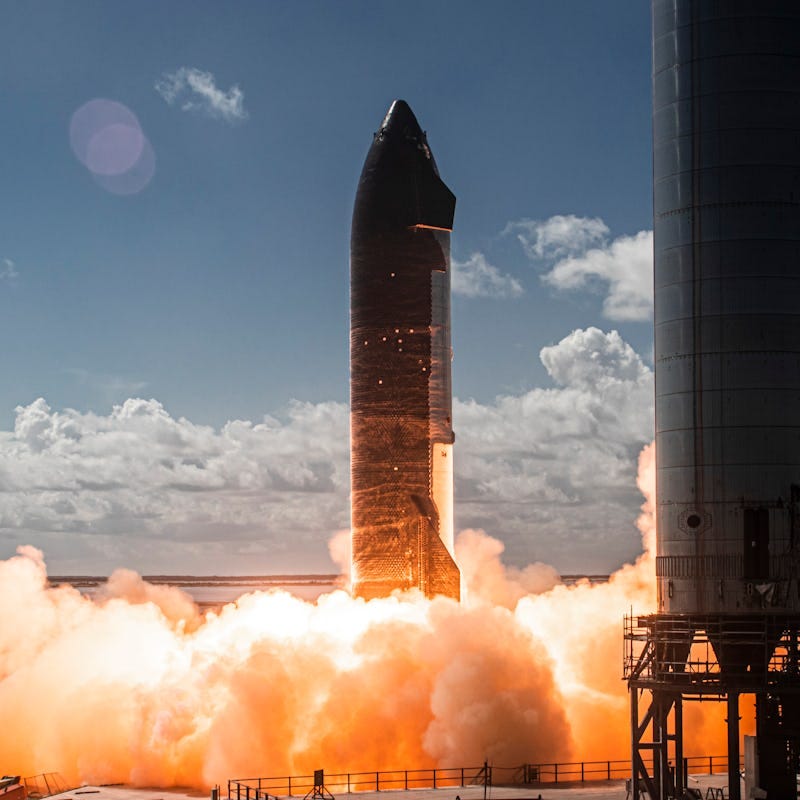
Starship was designed as a reusable super-heavy transportation system to carry cargo and crew to Earth orbit as well as for lunar missions, capable of deploying over 100 metric tonnes to orbit. As part of Space’sX long-term strategy, Starship will be capable of busing up to 100 individuals on long-duration, interplanetary flights, whether to the future Moon base or beyond. Starship is expected to commence commercial payload delivery into orbit in e2h26.
Dragon is a spacecraft designed to be launched by Falcon 9. This vehicle is capable of carrying upwards of 7 crew into Earth orbit as well as transporting cargo to and from Earth as the first private spacecraft to transport crew members to the International Space Station [ISS]. Dragon gained recognition in 2024 when the spacecraft was used in a rescue mission to transport stranded NASA astronauts back to Earth from the ISS.
Falcon 9 is a reusable, two-stage rocket designed to transport crew and cargo into Earth orbit. This vehicle is most heavily utilized as the workhorse for launching SpaceX’s Starlink satellite constellation into Low Earth Orbit [LEO]. Falcon 9 has completed 638 missions, 557 of which have been reflights. A key factor of Falcon 9 was its ability to drastically lower the cost of launch from $18,500/kg to $2,700/kg, an 85% reduction in costs.
Falcon Heavy was the latest addition to SpaceX’s launch fleet, capable of transporting 64 metric tonnes of cargo into orbit. The vehicle gained the public’s attention in its first launch when Musk sent a Tesla Roadster on a mission to Mars in 2018, making it the first production vehicle launched into space. The Falcon Heavy also produced a significant reduction in the cost of delivering cargo, dropping by 92% to $1,400/kg.
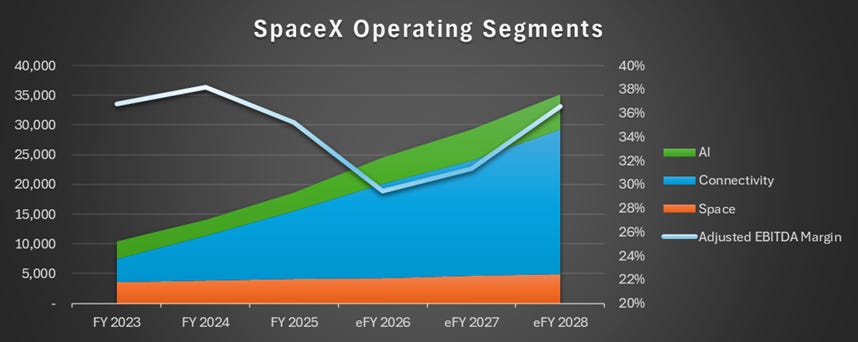
SpaceX is made up of a number of distinct business verticals as part of an expansive effort to monetize in the space economy. For launch, SpaceX utilizes its rocket fleet for civil, commercial, and defense missions, providing rideshare capacity for peer satellite companies.
SpaceX also plays a critical role in NASA’s Artemis program, a multi-year, multi-phase lunar development project for creating an inhabitance on the lunar surface. Accordingly, SpaceX provides the Human Landing System [HLS], a variant of Starship, which is the vehicle designed to transport astronauts from lunar orbit on the Orion spacecraft down to the Moon’s surface and back. The initial contract was valued at $2.9b and was expanded by $1.15b for a second crewed landing mission. The mission was slated to be a part of the Artemis III project, which is slated for a 2027 mission. In addition to spacecraft, SpaceX is participating in the program by transporting critical infrastructure for the Lunar Gateway to develop an autonomous, inhabitable lunar base.
In March 2026 Jared Isaacman, NASA Administrator, announced the intention to accelerate lunar development with a monthly launch cadence to develop functional infrastructure on the South Pole of the Moon, including the development of a Moon base. While the development of a Moon base isn’t necessarily a novel topic of discussion, the actionable development of the infrastructure through private, commercial enterprises has yet to be touched. This can be a major program for SpaceX to participate in over the coming years, particularly when considering the total ecosystem of infrastructure developed between SpaceX and Tesla.
On the commercial side of the business, Starlink is the largest satellite constellation with over 6,000 satellites in operations. SpaceX began deploying Starlink in 2019 with a fleet of 60 satellites as part of the beta program before scaling up to its global constellation for near-global coverage. As of the release of SpaceX’s S-1 filing, Starlink had 10.3mm subscribers, making it the most viable broadband satellite connectivity company in existence. Furthering the program, SpaceX began deploying direct-to-mobile satellites in early 2024, initially providing text and emergency services before scaling to voice, data, and IoT services through partnerships with mobile carriers like T-Mobile in the US as well as Telstra, KDDI, Rogers, and Salt, amongst others, internationally. As part of its direct-to-mobile business, SpaceX entered into a Spectrum License Purchase Agreement with EchoStar to license up to 15MHz of unpaired AWS-3 spectrum valued at $19.6b. The deal involved $11.9b in equity, $8.5b to the payoff of designated EchoStar debt, and any shortfall below $8.5b to be paid in cash. The deal is expected to close in November 2027 and has been approved by the FCC.
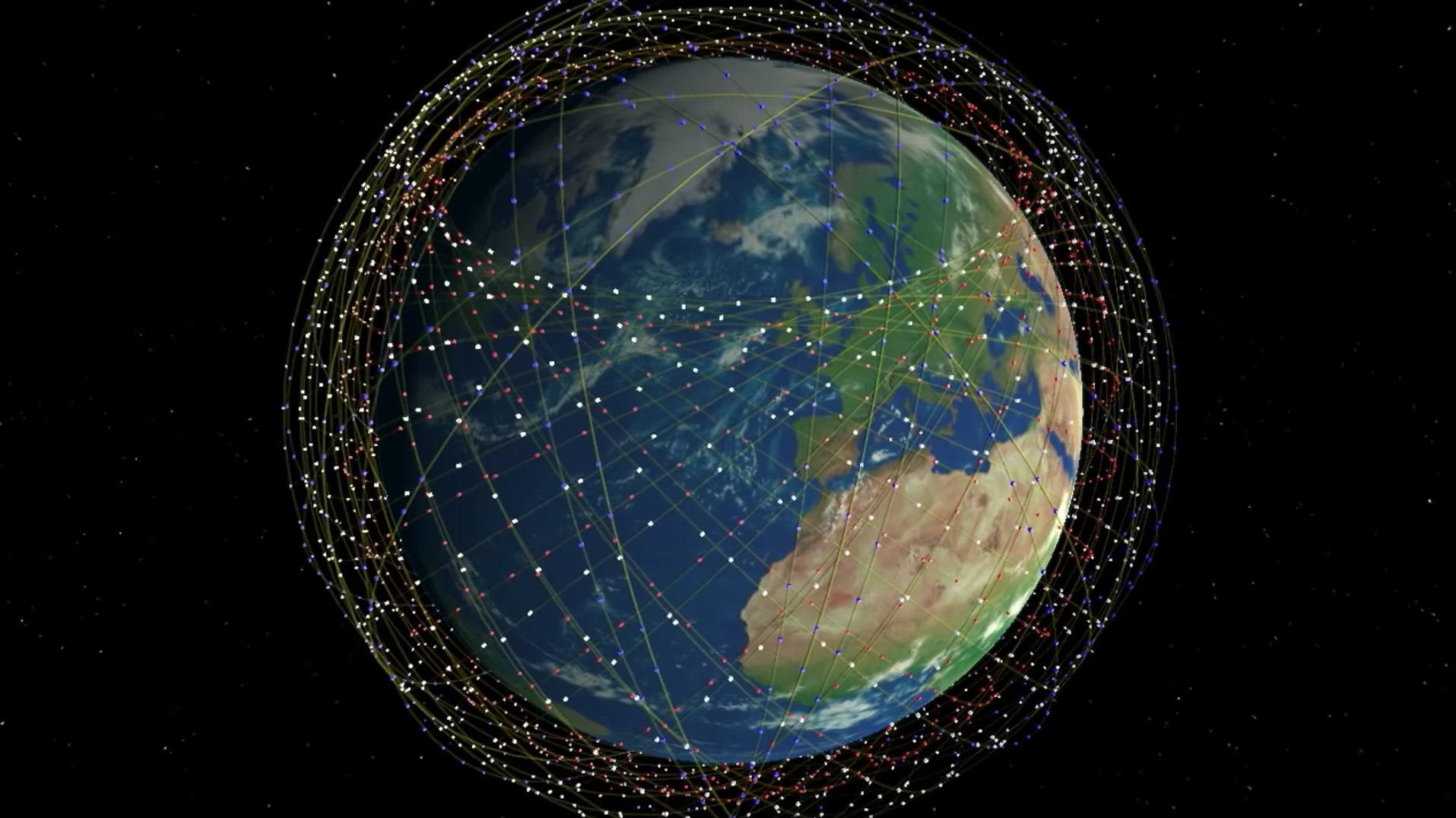
SpaceX also offers enterprise solutions as part of its Starlink business, providing connectivity to a variety of sectors, including construction, agriculture, retail, and telecom, amongst others. Starlink has the capability to be deployed on a variety of structures and vehicles, including aircraft, ships, trains, oil rigs, and facilities to provide broadband connectivity.

In May 2025, SpaceX and xAI merged into a single operating company, combining Musk’s space exploration company with X Corp. [Twitter] and its AI development efforts. In addition to this, Tesla intertwined the organizations through an equity investment in SpaceX, calling the collaborative AI project “Macrohard,” likely a jab at Microsoft.
In early 2026, xAI secured an agreement with Anthropic to utilize 300MW of compute capacity at xAI’s Colossus 1 data center in Memphis, Tennessee, which is set to yield $1.25b in revenue per month through May 2029 with the option to be extended and scale. While the agreement will provide for a substantial revenue source, we believe that it may be suggestive of adoption and development challenges faced by xAI following lackluster performance and advancement when compared to peer models provided by Google [Gemini] and Anthropic [Claude]. Rather than attempting to compete in a high-cost market, xAI’s shift towards data center hosting may be a more appealing strategy and utilization of resources as the company repositions and refocuses on its broader efforts.
SpaceX also entered into an agreement with Anysphere [Cursor] to provide GPU clusters to collaborate and further develop xAI’s Grok. In addition to this, SpaceX is considering an acquisition of Cursor valuing the company at $60b.
To further develop its AI capabilities, xAI established a partnership with Intel Corp. (INTC) to develop Terafab, a multi-generation semiconductor fabrication program designed to produce upwards of 1mm chips per month when fully scaled. Terafab will operate on Intel 14a process technology, which will begin ramping up in the 2027-2028 timeframe. As part of the program, Intel will be contributing chip design, fabrication, and packaging for SpaceX. Terafab will fabricate both logic and memory chips purpose-built for SpaceX and Tesla Optimus and vehicles.

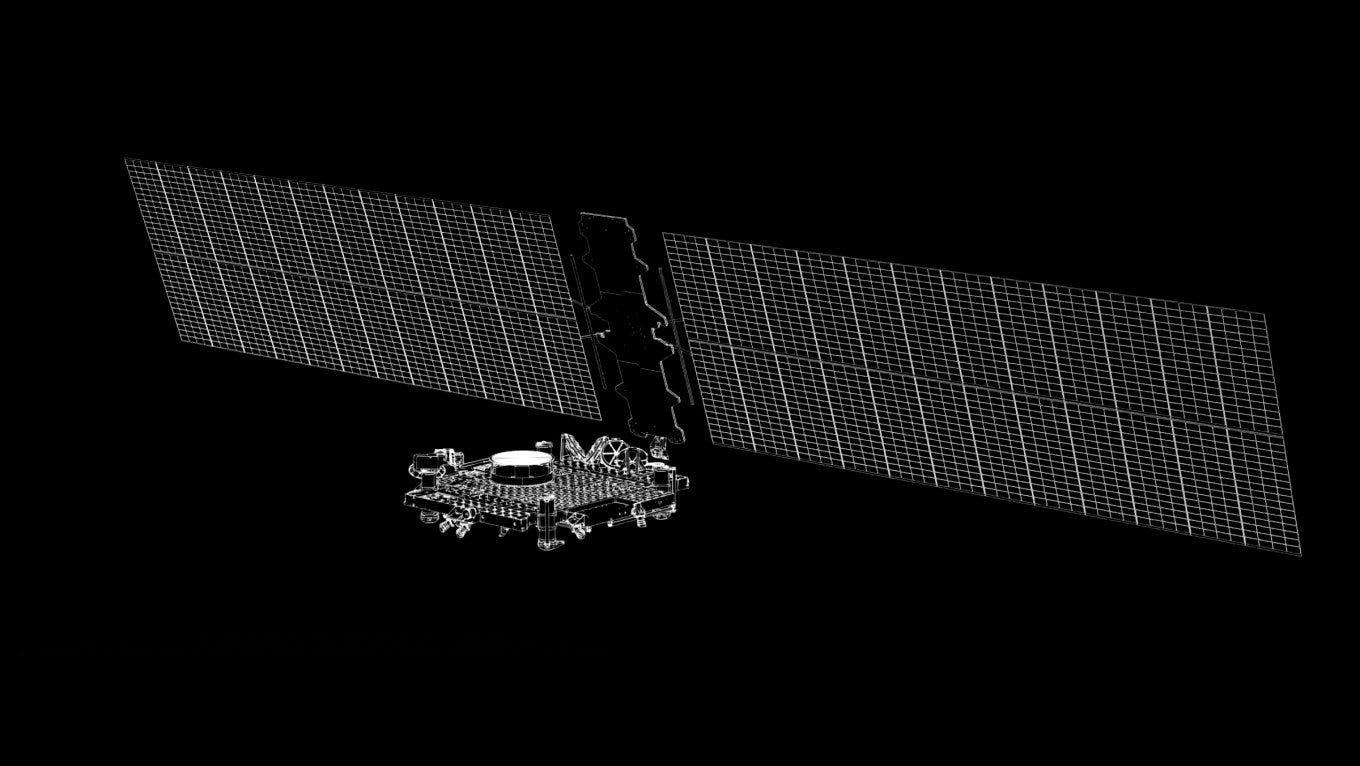
Advancing its commercial efforts, SpaceX has the vision of integrating satellite communications with xAI by developing the software and hardware infrastructure for a constellation of orbital data centers, leveraging solar arrays for continuous power generation. While this may seem like a farfetched idea, orbital AI inferencing may be the next frontier as a component of SpaceX’s broader infrastructure theme. Taking into consideration that SpaceX controls launch, satellite communications and direct-to-device satellites, orbital data centers could potentially shorten the path from data center to satellite to device, providing lower latency if successful. This can particularly be critical for Musk’s broader autonomous platform for self-driving vehicles and humanoid robots, connecting each node through satcom for real-time operations.
As for defense, SpaceX operates Starshield, which was established in late 2022. The program was effectively an adaptation of Starlink designed for defense agencies for the US and allied nations. Starshield is a government-owned system built for military applications with end-to-end encryption and anti-jam/anti-spoof features. The constellation involves multiple layers, including communications, reconnaissance, and missile warning and tracking, providing defense agencies a vertically integrated constellation.
SpaceX operates under a number of contracts with various agencies on its Starshield program, including the National Reconnaissance Office [NRO], US Space Force, the Space Development Agency [SDA], and the State Department. SpaceX also does business with Axiom Space, SES, Eutelsat, and OneWeb.
